Pink Salmon

The Forth District Salmon Fishery Board have confirmed that a Pink Salmon has been caught on the River Leven (the Fife version).

First confirmed Pink Salmon caught within the Forth District on the River Leven (Fife). If you catch a pink salmon or humpy, then please, if possible, keep the salmon alive and phone 0131 447 1527 (or send a message via Facebook) so the one of the River Forth Fisheries Trust’s biologists can arrange for samples of tissue to be taken. If not possible, then please dispatch it as humanely as possible. The Trust Biologists would still like to be have a look at the fish to establish sex, age (though scale samples), likelihood of spawning, etc. Location of the fish when caught is also useful.

If you are aware of any other pink salmon caught in the District please let us know.

Thanks

Some information of the species can be found here – http://www.adfg.alaska.gov/?adfg=pinksalmon.main

Please be aware

Posted in DAA News, River fishing, River journal | Leave a comment

DAA work parties – mid week volunteering opportunities

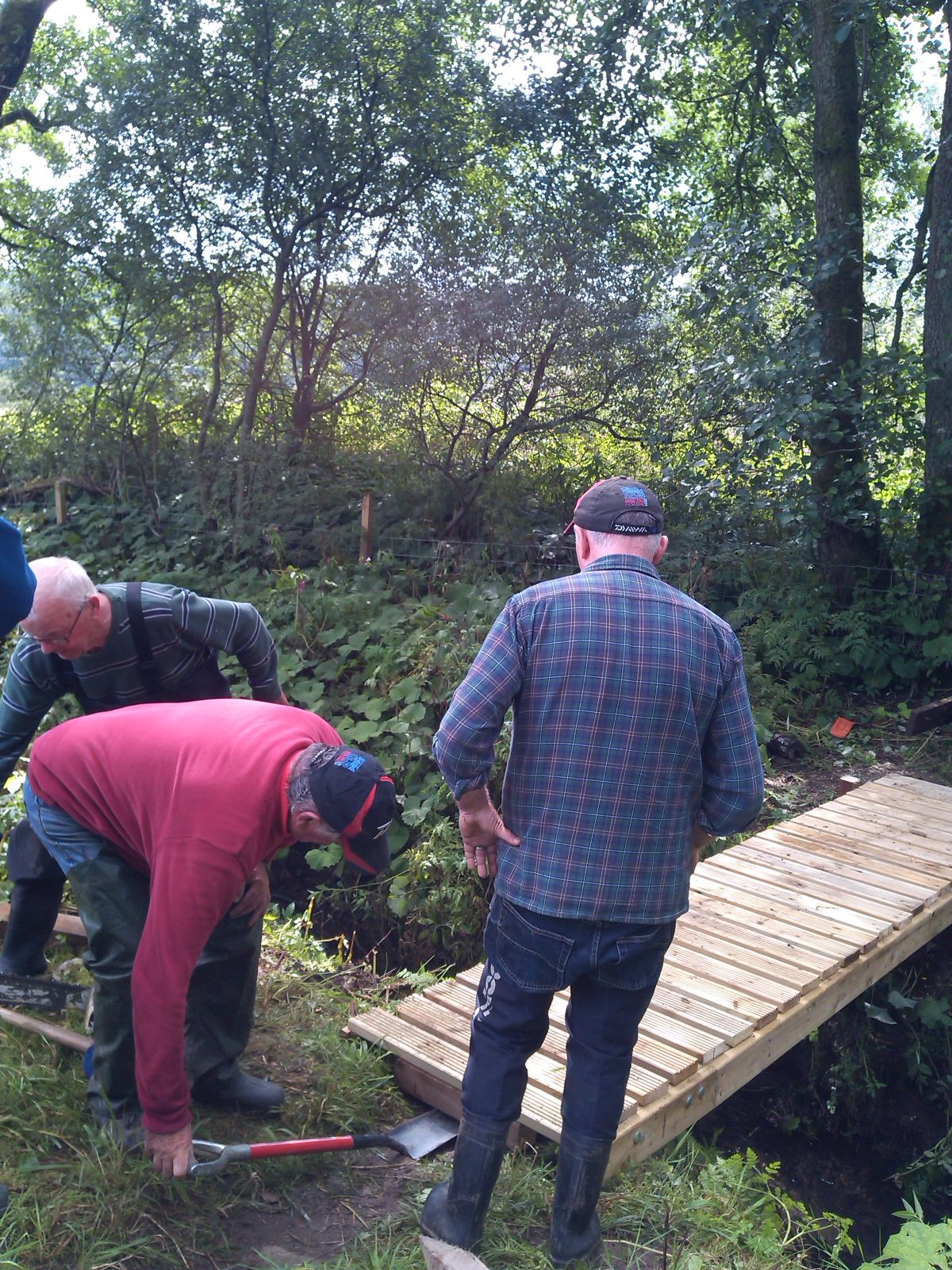
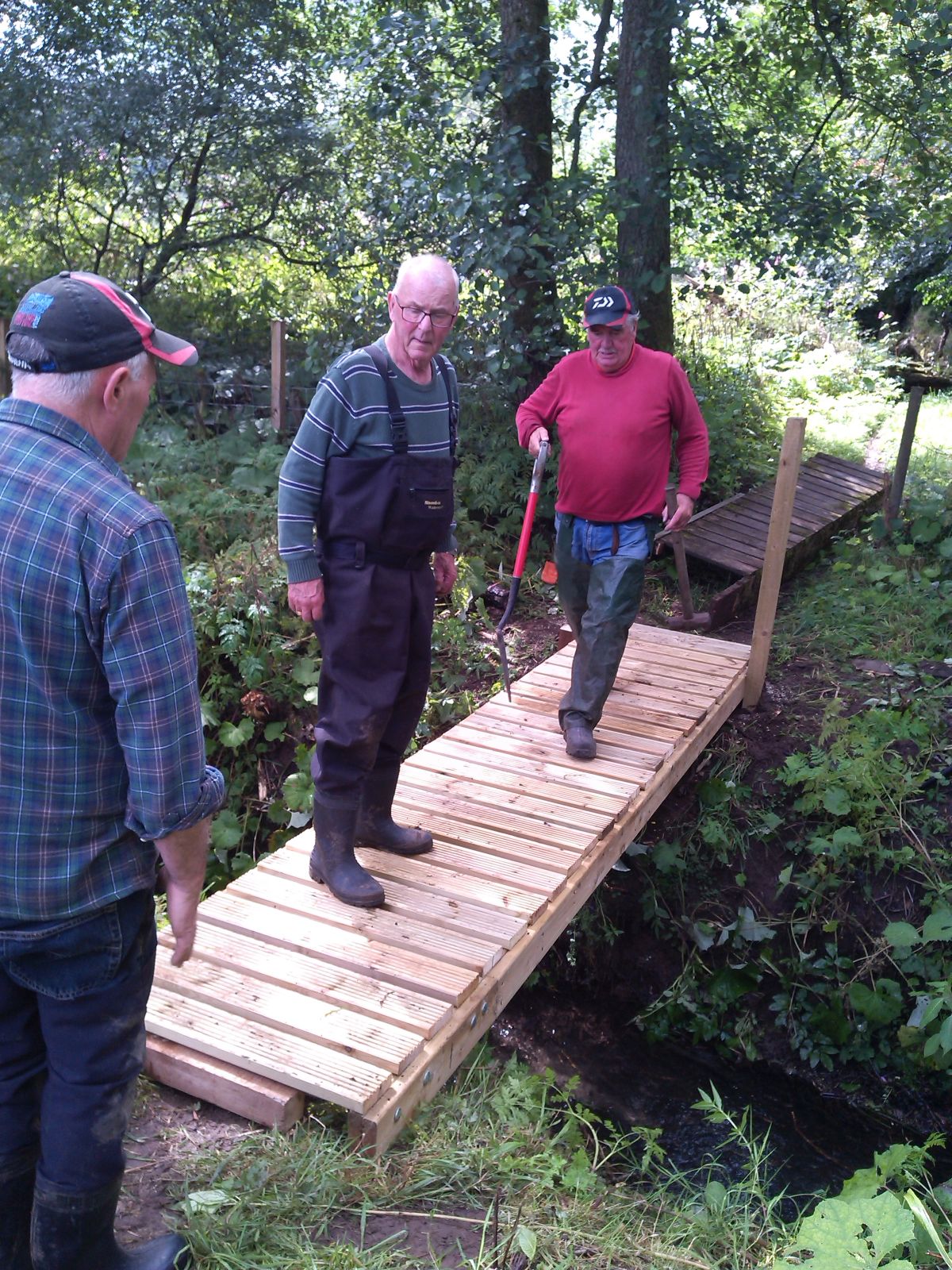
The routine work parties on the Devon and Glenquey are generally during the middle of the day on a Wednesday. The work is varied ……… anything from building stiles/bridges, clearing shrubbery, removing blockages from the spawning burns, clearing fallen lumber and at this time of year the biggest task, maintaining paths and access by mowing/strimming. Volunteers just need to be willing; the DAA will provide any tool that you might possibly need with a lot of good banter!

If you fancy getting involved, as a rule the guys meet up in Tillicoultry about 11am Wednesday before heading out to the designated work area.

If you are interested and would like to give a hand, on a regular or even occasional basis please give Alan Armstrong a bell (01259 751120) and he will provide you with the rendezvous information.

Any assistance will be gratefully received 🙂

Posted in DAA News | 1 Comment

Marine Scotland Salmon tracking project

We have a request from the Scottish Government agency Marine Scotland (the Freshwater Fisheries Laboratory at Pitlochry) for salmon anglers to watch out for tagged salmon over coming seasons.

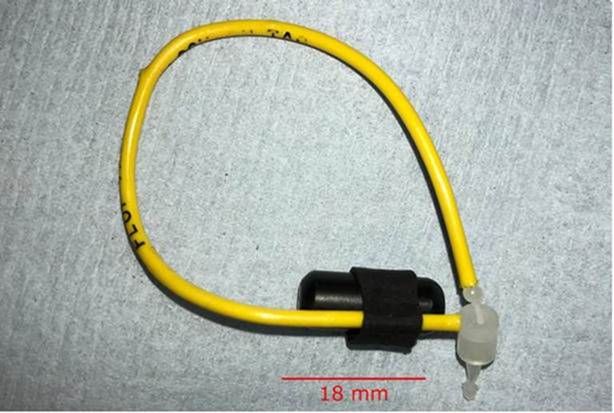
From July 2017 Marine Scotland (in conjunction with local DSFBs and Fisheries Trusts) are tagging and tracking salmon. If you are fortunate to catch and land a salmon on the Devon or any other water please look out for tags like this near the dorsal fin:

The colour of the cord may vary from yellow shown in the photo.

Subject to being able to maintain the welfare of the fish, please remove the plastic cord, by carefully cutting through itand then retrieving/retaining the acoustic tag (black plastic approx. 18mm in length). Please then forward to Marine Scotland with the details of the catch (location, date plus any information on the fish condition such as sex, length, weight and photos ) and your own details (name, email and address) to:

Armadale Tracking, Freshwater Fisheries Laboratory, Faskally, Pitlochry, PH16 5LB

In return you will be sent £20 for your troubles

Posted in Uncategorized | Leave a comment

Found – House Key at Tait’s Tomb car park

If you have lost a brass house key at or about the car park at Tait’s Tomb please contact Cailean Moore or the DAA and we will endeavour to reunite you with your key 🙂

Posted in DAA News | Leave a comment

Become a Flood Warden Volunteer

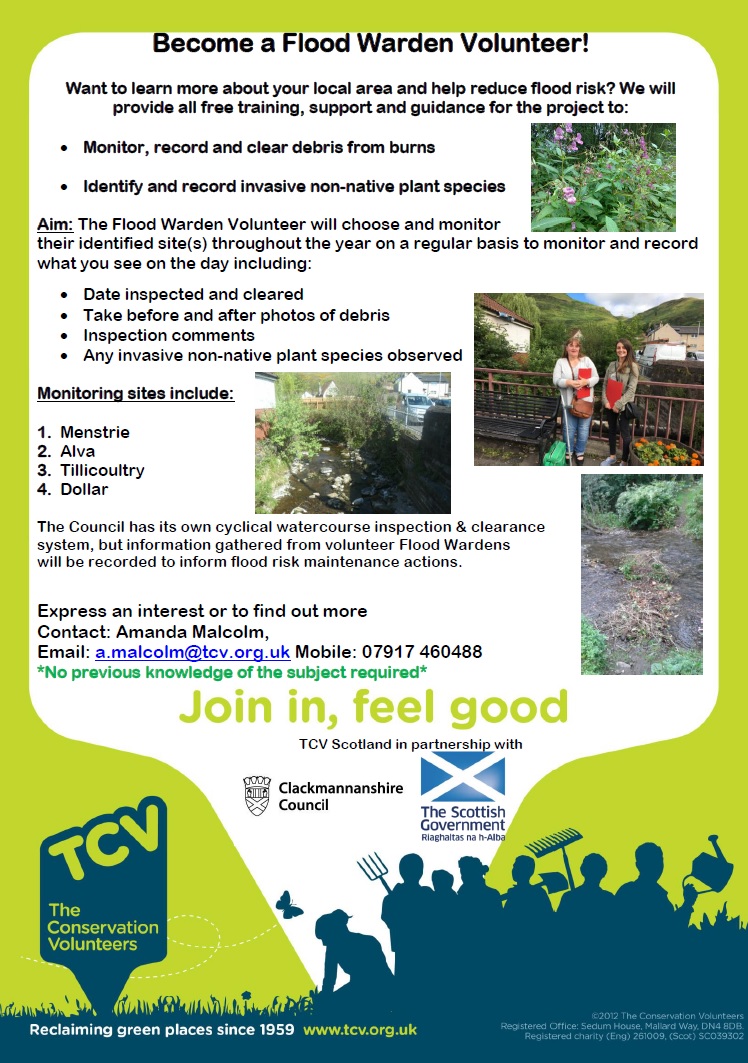
The Conservation Volunteers in conjunction with Clackmannanshire Council and Scottish Government are seeking volunteers from the Hillfoot towns to act as volunteer Flood Wardens.


They will provide free training, support and guidance to:

  • Monitor, record and clear debris from burns
  • Identify and record invasive non-native plant species

Flood Warden Volunteers will choose and monitor chosen sites throughout the year on a regular basis to monitor and record what you see on the day including:

  • Date inspected and cleared
  • Take before and after photos of debris
  • Inspection comments
  • Any invasive non-native plant species observed

Monitoring sites include:

  1. Menstrie
  2.  Alva
  3. Tillicoultry
  4. Dollar

Express an interest or to find out more (no previous knowledge of the issues is required!)

Contact: Amanda Malcolm,

Email: a.malcolm@tcv.org.uk Mobile: 07917 460488

Full details can be found on the flier below:

Flood Warden poster FINAL

Posted in DAA News, River Devon miscellaneous | Leave a comment

A summer spate? ……… continued

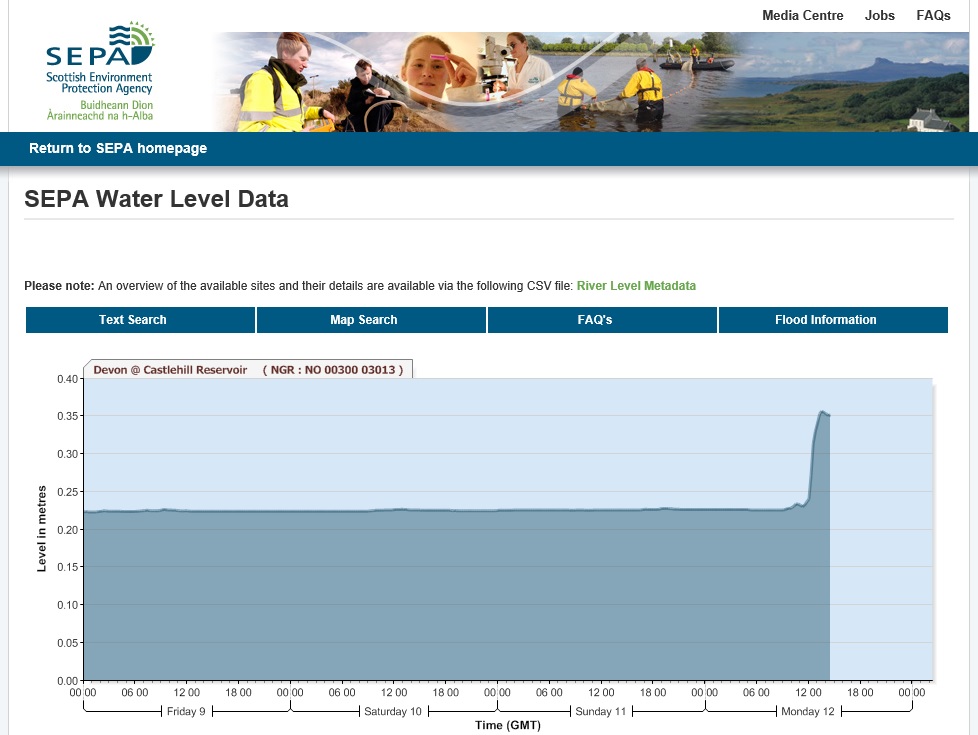
A follow up on last weeks post as I noticed late this afternoon an interesting event on the SEPA gauges:

I passed Castlehill this evening on my way home and in little over a week it has been refilled to the brim. I am not sure whether this is overtopping or Scottish Water releasing water to generate hydro-electric power?

I suspect that it will be the later. These small scale releases tend to come in rapid releases raising the river by about 10-15cm (similar to the profile shown). In some respects for the trout angler in the upper river they are welcome as they help clear some of the accumulated algae and silt but are no substitute for natural spates.

Proper spate events on the Devon are obviously important to the salmon and sea trout population allowing them access to the river and ultimately their spawning grounds. They are however every bit as vital to our resident brown trout, as these events transport fresh sand/gravel deposits through the river system and removes accumulated fine sediment. This provides improved habitat for fish, the invertebrates that they rely on and fresh gravels for spawning redds.


Posted in River Devon miscellaneous, River fishing, River journal | Leave a comment

A summer spate …….. maybe?

In time honoured fashion just as my delphiniums come into bloom ……… the weather breaks resulting in them being flattened by the incessant rain and wind. There has been a wee bit of discussion here and on Facebook what condition the river will be in over the next couple of days so I though it might be interesting to illustrate the impact of water abstraction on our water.

According to the SEPA rain gauges, in the last 36hours up to 9pm  37.2 mm of rain was recorded in Drum (Crook of Devon), 26.6mm in Tillicoultry, 48.4mm at Balado and 42.6mm at Kinkell Bridge (on the other side of the Ochils). On most rivers this would result in a big clearing spate but not necessarily so on the Devon.

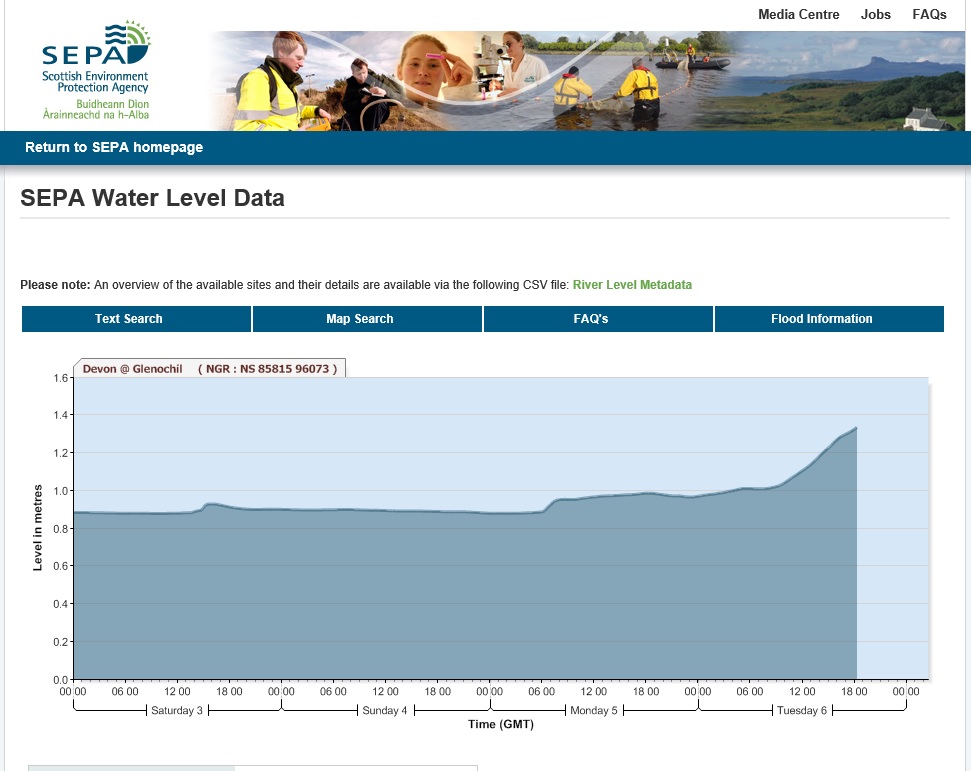
It is worth looking at the SEPA river level gauges on the Devon and compare with some of our neighbours using some screen grabs from earlier in the evening, firstly the lower river at Glenochil:
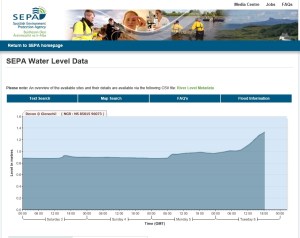
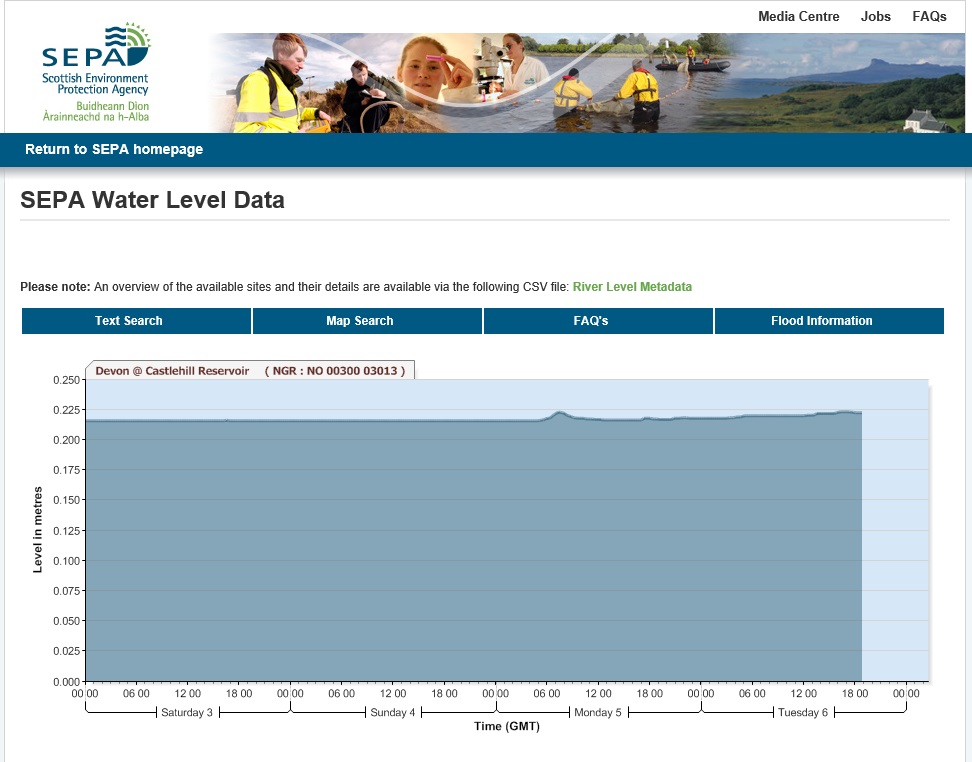
The gauge on the lower river was showing a steady rise in river level to about a foot (and is still rising when I last checked). Now the gauge downstream of Castlehill Reservoir

Despite at least an inch of rain the change of level is measured in millimetres.

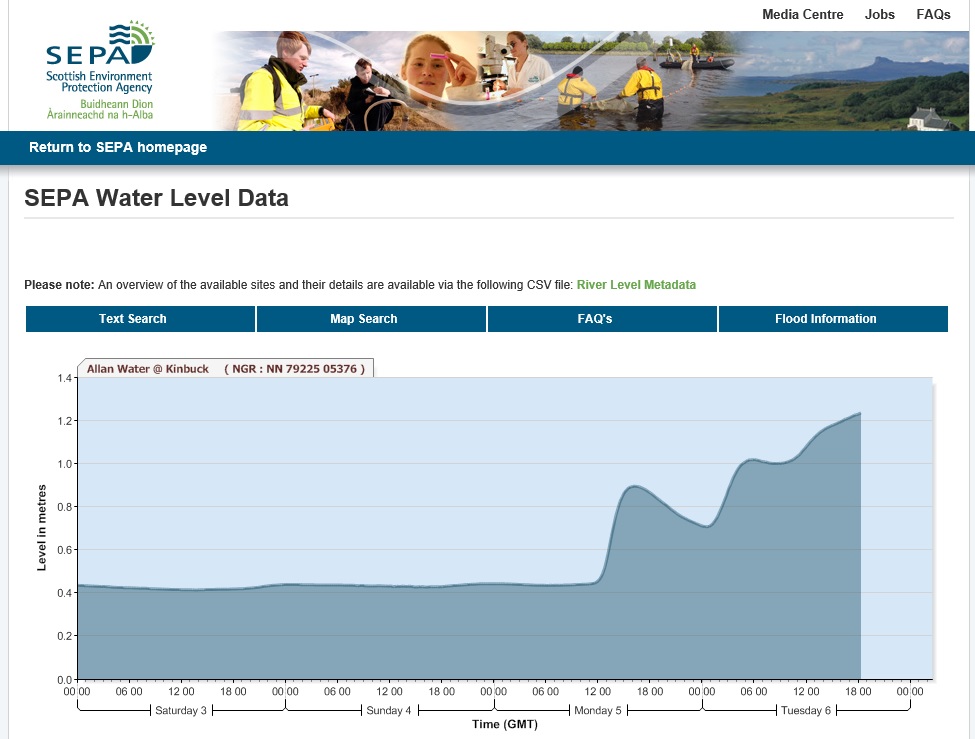
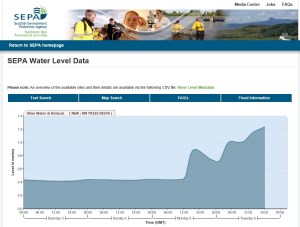
Now compare these with two other Ochils related SEPA gauges, firstly the Allan Water at Kinbuck:
and the North Quiech at Lathro, near Milnathort (a major feeder burn of Loch Leven):
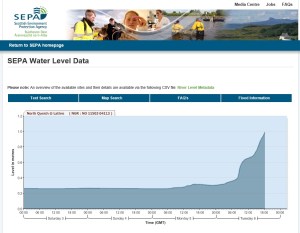
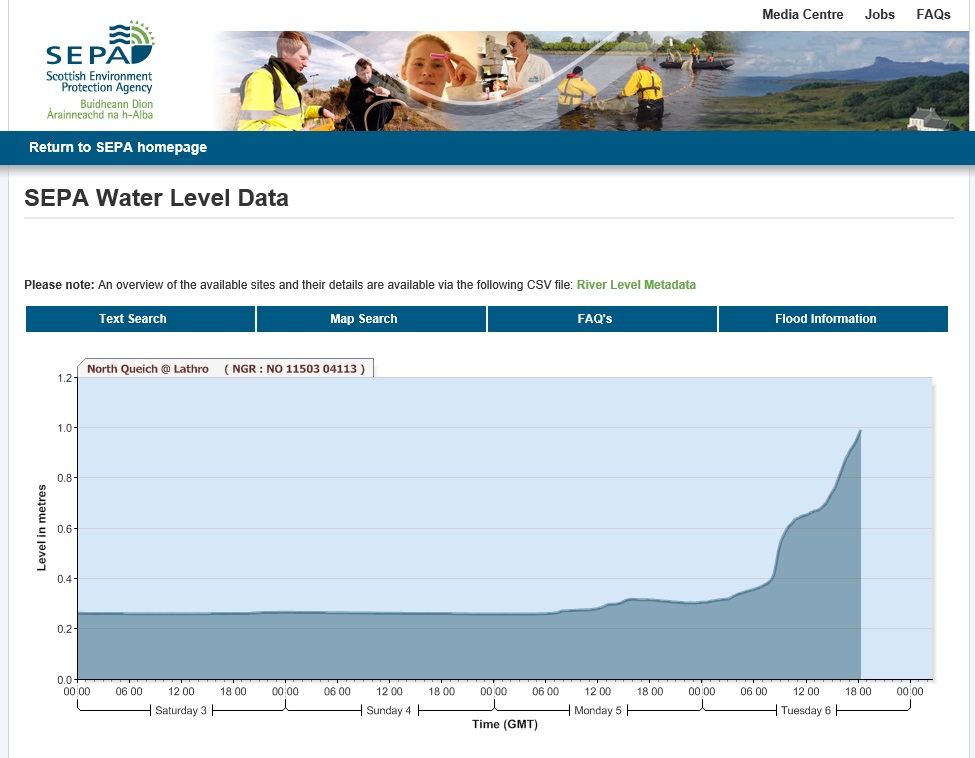
Both the Allan Water and the North Quiech have much quicker responses to rainfall and generate much larger spates despite having very similar catchments. The explanation of the difference is of course simple.

Scottish Water

The headwaters of the river are effectively impounded by Castlehill Reservoir. It acts as a strategic reserve (it has to be pumped to the Glendevon WTW, while all the other reservoirs deliver water for treatment by gravity). I guess during the prolonged dry spell water is held in the upper reservoirs while Scottish Water draw down Castlehill to maintain their legal obligation to provide compensation flows to the river.   Anyone passing Castlehill Reservoir will realise just how low the water level is (I understand that they have had to suspend fishing there for moment). It will take a lot of rainfall to fill the reservoir to a level where it will be discharging over the spillways to increase the flows above compensation flow.

One of the unusual feature of the Devon below Castlehill is that there are very few feeder burns of note until the Gairney Burn is reached below the Cauldron Linn (there is the Glendey Burn in Dunning Glen, the Thorney Burn which joins the mill lade at Crook of Devon and a wee burn at the top of Rumbling Bridge). Most of the drainage from surrounding fields is lost to groundwater flows (including part of the compensation flow) to reappear in the river away downstream. At these times spates in the lower river  are much less significant then on surrounding waters as the additional water is generated by flows from the Gairney and the main Hillfoot burns only.

The impact of abstraction therefore has a significant impact on the river basin:

  • The upper river, pretty much all the way above the Cauldron Linn remains clean during rainfall events unless Castlehill is over topping.
  • The prolonged steady flows of compensation water results in excessive sedimentation which has a consequential impacts on the riparian environment
  • Part of the compensation flow is lost to groundwater flows
  • The lower river is far less sensitive to rainfall events than neighbouring rivers restricting access and opportunity for migratory fish entering the river.

So I can predict that below the Cauldron Linn tomorrow there will be a decent spate and the river will pretty dirty. I think with the continuing heavy rain overnight the Glendey Burn, field drains and groundwater will raise the upper river above the Cauldron Linn a good deal, clearing the accumulated sediment quickly ……… fishable possibly but if I had to fish tomorrow I would head to Glenquey!

Will this bring some Slob or  Sea Trout into the river?

Posted in River fishing, River journal | 5 Comments

Glenquey catch returns – IMPORTANT

A gentle reminder for all anglers fishing at Glenquey; we really need your help to make sure that all catches are recorded on the permit and returned to the DAA. Knowing the numbers of fish caught, fish returned, fish taken and their general condition (and any other relevant information) is really important information which helps inform the management of this wonderful fishery.

A lot of you routinely complete your returns and the DAA are extremely grateful for your cooperation and assistance, but our goal is to get to as near to 100% returns as possible.

At the end of your session please fill out the return printed on your permit and return in the box provided. You will find this underneath the noticeboard on the path to the dam above the car park

Just lift the lid, post into the box and then close the lid.

Simple ………. but don’t forget to make sure you give your name and address. Completed catch returns returned to the box are entered into a monthly draw and one lucky angler receives a free permit!

If you have been unlucky enough to have a blank then please still complete the return anyway …….. you still have a chance in the draw to win another day 🙂


Posted in DAA News, Glenquey fishing, Glenquey journal | Leave a comment

Forth District Salmon Fishery Board – annual public meeting

The  Forth District Salmon Fishery Board are holding their annual public meeting on Wednesday 31st May 2017 at Dunblane Cathedral.

Public begins at 7pm and the agenda is:

  1. Appologies for absence
  2. Minutes of the last meeting – open session only
  3. Matters arising therefrom
  4. Reports
  • Clerks Report
  • Teith Bird Count and walk overs
  • Lanrick Weir fish pass counter report
  • Redd Count report
  • Wild Fisheries Reform Lite – whats left of the reform process
  • Revaluation update

At 8pm they will be a talk presented by Dr David Summers from the Tay DSFB giving a talk on ” Re-watering the River Garry”  (SSE restoring flows to the River Garry in Perthshire which current loses much of its flow to the Hydro-electric schemes.

Posted in DAA News, River fishing | Leave a comment

Get PLUCKING ……… help control Himalayan Balsam

Alan Graham made a great post on the home page encouraging all anglers to get plucking ……. Himalayan Balsam!

So why and how?

The river is blighted by two principal invasive plant species ……….. Japanese Knotweed and Himalayan Balsam. On the upper river the main problem are isolated but significant stands of Japanese Knotweed which we hope we can deal with through the Fisheries Trust Finns Project or if necessary with our own resources.

From Vicars Bridge downstream while there are areas of Japanese Knotweed (some of which were treated by the Ochils Landscape Partnership) the main problem is Himalayan BalsamWhile the flowers are a fabulous source of nectar for honey production it is highly invasive, exclude traditional bankside plants but providing no real root structure to protect the banks from erosion in spate.

The Association work parties expend enormous energy each year trying to cut as much of the infestation down before it has time to seed. There are isolated pockets of Himalayan Balsam particular tight to the banks (away from the mower and strimmers) were our anglers could make a huge contribution by plucking any Himalayan Balsam plants they come across ………. just ten minutes on every trip by every angler could make a huge difference.

Waiting for a rise two years ago I came across this stand of Himalayan Balsam (downstream of Rackmill) in the early spring:

Literally five minutes of plucking later:

Deeply satisfying …….. the joy is there are virtually no roots so it is very easy to pluck

Grab the plant close to the ground and simply pluck. Throw the plant into a heap well above the river (it’s high moisture content ensures it rots quickly). There is no real effort involved and you get the satisfaction of knowing having expended hee-haw energy you have made a real contribution to the River Devon’s health and the work of the Association

Now is the perfect time to get plucking!


Posted in DAA News, River Devon miscellaneous, River journal | 1 Comment